Electronics
An Arduino Uno drives nine photoresistors placed under the squares of the board. RGB LEDs built into each square light up red or blue, and a 16 × 2 LCD connected over I2C shows the turn, the score and the outcome of the game.
Embedded electronics
An interactive tic-tac-toe game designed for children: light sensors tell opaque red tokens from translucent blue ones, and the game is shown on a screen.
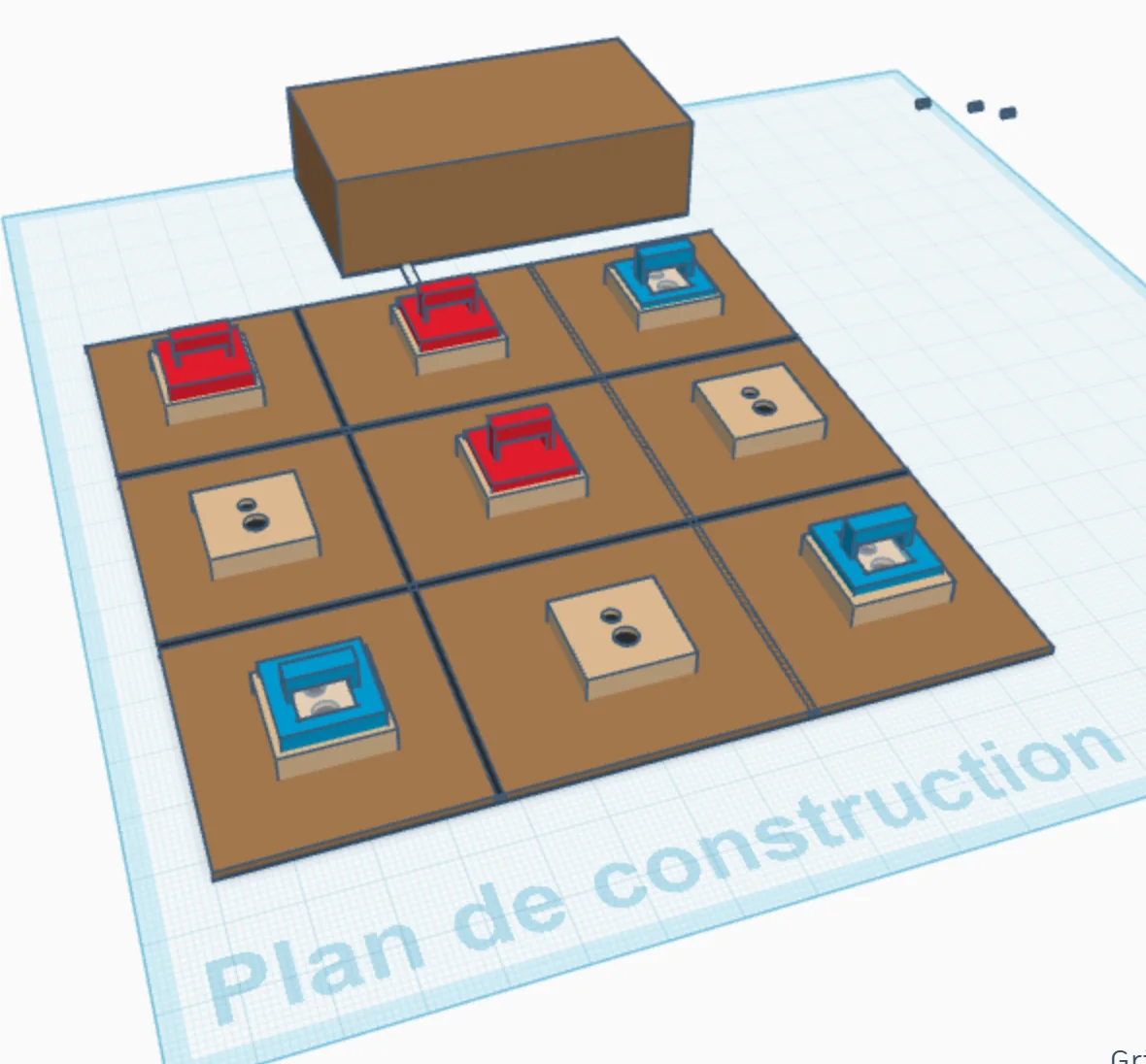
In our second year at ISEN Nantes, our team of four students designed, in one month, an electronic tic-tac-toe game for a children's holiday camp. It is played as a relay and relies on light sensors and LEDs to make the game interactive.
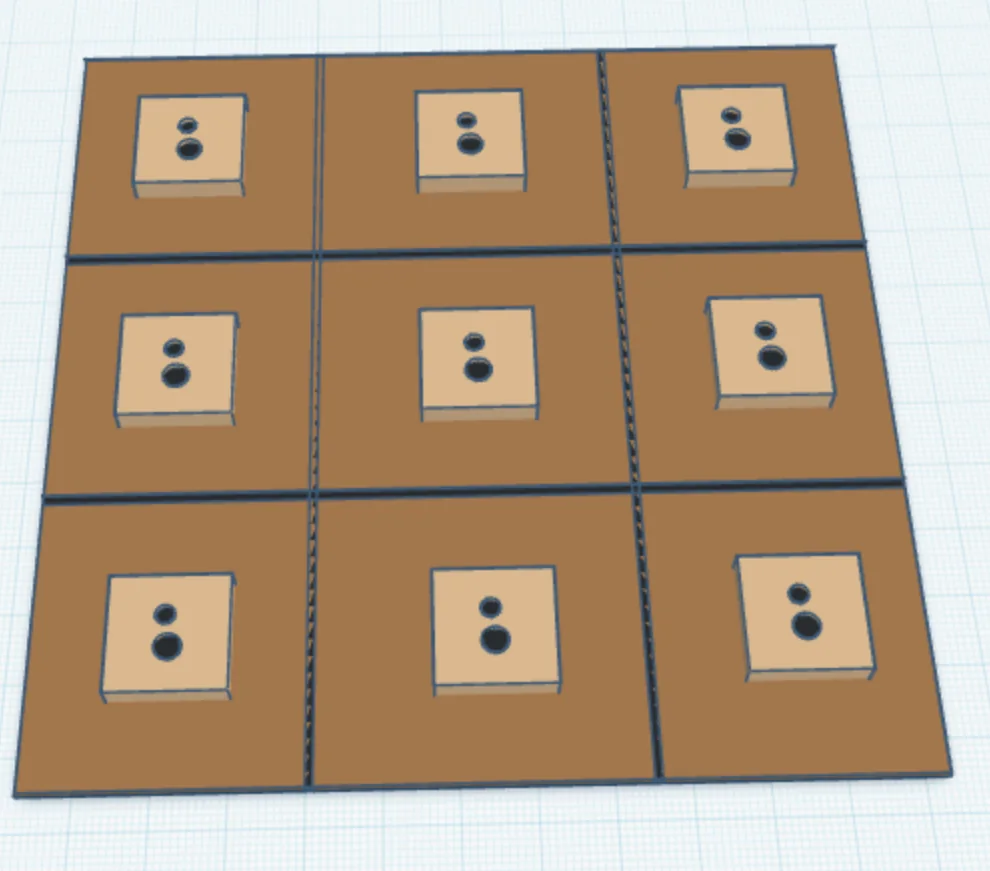
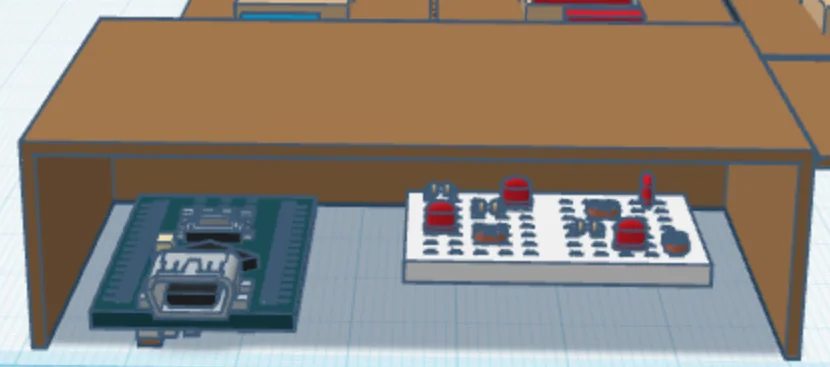
The wooden board has nine drilled squares, set on laser-cut cardboard bases. Under each square, a light sensor tells opaque red tokens from translucent blue ones. LEDs signal each move and an LCD screen shows the state of the game. An Arduino board and a breadboard, housed in a cardboard box, drive the whole system.
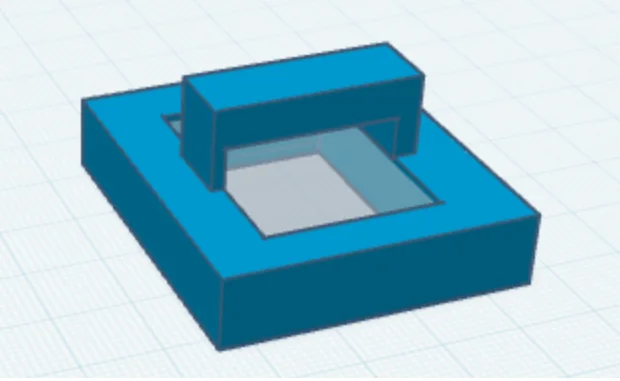
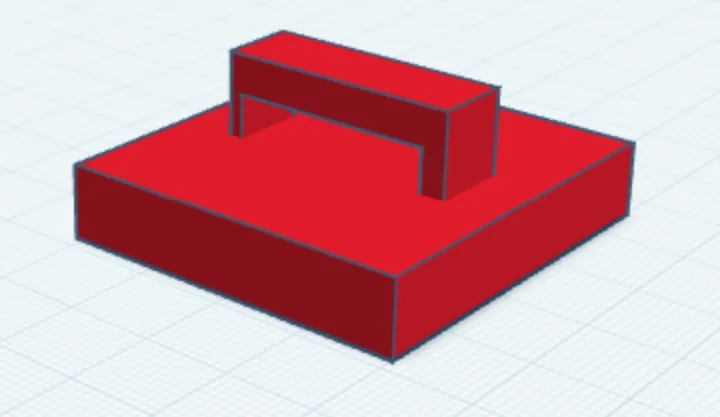
The tokens were 3D-printed for durability and looks: opaque red plastic on one side, translucent blue with plexiglass parts on the other, to maximise the contrast in light.
From sensor to screen: what happens when a child places a token.
An Arduino Uno drives nine photoresistors placed under the squares of the board. RGB LEDs built into each square light up red or blue, and a 16 × 2 LCD connected over I2C shows the turn, the score and the outcome of the game.
Each photoresistor returns an analogue light-intensity value. Calibrated thresholds (about 200 for a red token, 600 for a blue one) identify the token placed. Software filtering discards outlier readings.
The Arduino program, written in C++, reads the sensors every 100 ms, updates the game state, checks for winning lines and manages the relay turns.
Laser cutting for precise alignment of the board squares and the box, 3D printing for the tokens.
The photoresistors were calibrated under various lighting conditions to tell apart an empty square, an opaque red token and a translucent blue token. LED sensitivity and the LCD display were tuned alongside. Under controlled conditions the system proved reliable; for lack of time, it could not be tested with children.
The project was presented to the ISEN Toulon jury, who praised its intuitive design, its visual interactivity and how well it suits young players, while noting the lack of real-world testing.